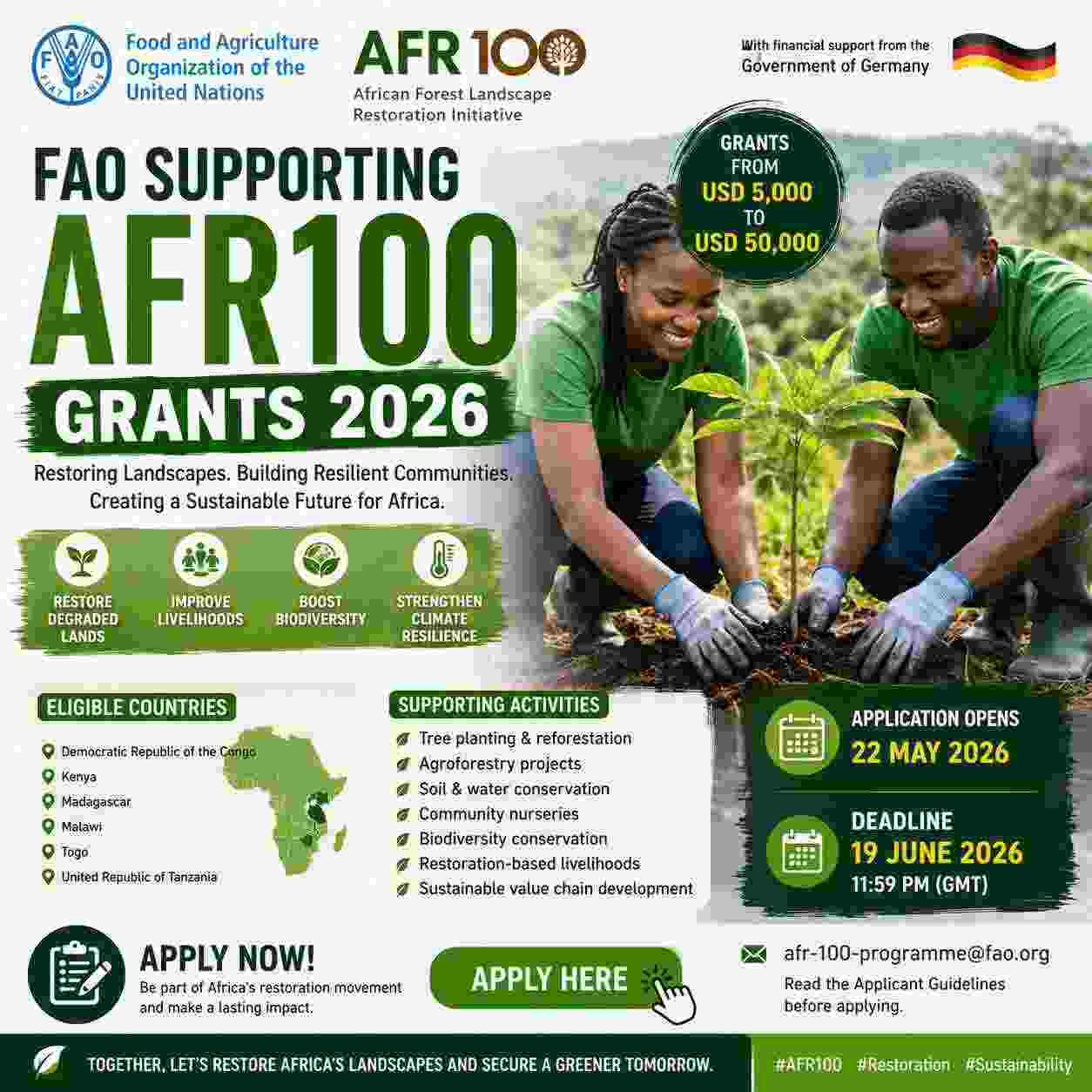
Imagine receiving up to $50,000 to restore ecosystems, combat climate change, and uplift local communities—the FAO Supporting AFR100 Grants 2026 make it possible. The Food and Agriculture Organization of the United Nations (FAO), with financial support from the Government of Germany, has officially opened applications for the FAO Supporting AFR100 Grants 2026 under its Direct Beneficiary Grants (DBG) scheme.
This funding opportunity is designed to support local organizations that are actively restoring degraded landscapes, promoting biodiversity conservation, improving climate resilience, and creating sustainable livelihood opportunities within selected African countries. Eligible organizations can apply for grants ranging from USD 5,000 to USD 50,000 to implement practical restoration projects that deliver measurable environmental and socioeconomic benefits.
The grant initiative forms part of the broader African Forest Landscape Restoration Initiative (AFR100), a continent-wide effort aimed at restoring millions of hectares of degraded land while supporting economic development, food security, biodiversity conservation, and climate adaptation. Organizations involved in community restoration, agroforestry, sustainable land management, conservation, and environmental protection are strongly encouraged to apply for the FAO Supporting AFR100 Grants 2026.
FAO Supporting AFR100 Grants 2026 Overview
| Details | Information |
|---|---|
| Host: | Food and Agriculture Organization of the United Nations (FAO) |
| Eligible Countries: | Democratic Republic of the Congo, Kenya, Madagascar, Malawi, Togo, United Republic of Tanzania |
| Reward: | USD 5,000 – USD 50,000 Grant Funding |
| Deadline: | 19 June 2026 at 11:59 PM (GMT) |
| Application Link: | Apply Here or Email: afr-100-programme@fao.org |
| Scholarship Alerts: | To receive Scholarship Alerts on WhatsApp, Click HERE |
About the Supporting AFR100 Programme
The Supporting AFR100 Programme is a major restoration initiative implemented by the Food and Agriculture Organization of the United Nations (FAO) and funded by the Government of Germany.
The programme focuses on strengthening locally led restoration efforts across selected African landscapes by supporting organizations that are actively engaged in environmental restoration and sustainable natural resource management.
Recognizing that local communities are at the forefront of ecosystem restoration, the programme seeks to empower grassroots organizations with financial resources needed to implement impactful restoration projects.
The programme is currently being implemented in the following countries:
- Democratic Republic of the Congo
- Kenya
- Madagascar
- Malawi
- Togo
- United Republic of Tanzania
Through direct funding support, the programme aims to improve ecosystem health, increase climate resilience, enhance biodiversity, and strengthen livelihoods for local communities.
What Are the FAO Supporting AFR100 Grants 2026?
The Direct Beneficiary Grants (DBG) mechanism provides financial support to local organizations implementing restoration-focused interventions within eligible programme landscapes.
The grants are designed to encourage community-driven restoration solutions that address environmental degradation while generating social and economic benefits.
Under this funding scheme, eligible organizations can access grants ranging from:
- Minimum Grant: USD 5,000
- Maximum Grant: USD 50,000
Funding will be provided in local currency equivalents and must be used for approved restoration-related activities.
The programme emphasizes practical, scalable, and community-centered interventions capable of producing measurable outcomes.
Objectives of the FAO Supporting AFR100 Grants 2026
The programme seeks to support initiatives that contribute to:
- Restoration of degraded landscapes
- Climate change adaptation and mitigation
- Biodiversity conservation
- Sustainable natural resource management
- Improved food security
- Enhanced ecosystem productivity
- Sustainable livelihood development
- Strengthened community resilience
- Restoration-based economic growth
- Sustainable value chain development
By supporting local actors, the programme promotes long-term environmental sustainability while improving the well-being of communities that depend on natural resources.
Eligible Activities Under the Programme
Organizations may apply for funding to implement a variety of restoration-related interventions.
1. Tree Planting and Reforestation Projects
Projects focused on restoring degraded forests and landscapes through tree planting, reforestation, and afforestation activities are highly encouraged.
These projects may contribute to:
- Carbon sequestration
- Improved biodiversity
- Reduced soil erosion
- Improved ecosystem services
2. Agroforestry Initiatives
Agroforestry combines trees with agricultural production systems to improve productivity and resilience.
Supported activities may include:
- Farmer-managed natural regeneration
- Tree-based farming systems
- Integrated land management approaches
- Sustainable agricultural practices
3. Soil and Water Conservation Projects
Organizations can seek funding for activities that promote sustainable land and water management.
Examples include:
- Watershed restoration
- Water harvesting systems
- Soil fertility improvement
- Erosion control measures
- Land rehabilitation initiatives
4. Community Nursery Development
Funding may support the establishment or strengthening of community nurseries that produce quality seedlings for restoration activities.
Community nurseries play a critical role in ensuring a reliable supply of indigenous and climate-resilient tree species.
5. Biodiversity Conservation Projects
The programme supports interventions designed to protect and restore ecosystems and habitats.
Examples include:
- Habitat restoration
- Wildlife-friendly restoration
- Indigenous species conservation
- Ecosystem connectivity initiatives
6. Restoration-Based Livelihood Projects
Organizations can implement income-generating activities linked to restoration efforts.
These may include:
- Sustainable forest products
- Ecotourism initiatives
- Tree-based enterprises
- Community conservation enterprises
7. Sustainable Value Chain Development
Funding may also support projects that strengthen restoration-related value chains and create market opportunities for local communities.
Why the FAO Supporting AFR100 Grants 2026 Matter
Africa faces significant environmental challenges arising from:
- Deforestation
- Land degradation
- Climate change
- Biodiversity loss
- Unsustainable land-use practices
Millions of hectares of productive land have been degraded, threatening food security, water resources, ecosystem services, and rural livelihoods.
The FAO Supporting AFR100 Grants 2026 provide an important mechanism for financing local solutions that can reverse these trends.
Successful restoration initiatives can:
- Improve food production
- Increase climate resilience
- Restore ecosystem services
- Create green jobs
- Support sustainable agriculture
- Enhance biodiversity
- Improve water availability
- Reduce environmental vulnerability
- Strengthen rural economies
The programme recognizes that local communities possess valuable knowledge and experience needed to implement effective restoration solutions.
Who Can Apply?
This opportunity is particularly suitable for organizations involved in environmental restoration and sustainable development.
Potential applicants include:
- Community-based organizations
- Environmental NGOs
- Conservation organizations
- Farmer associations
- Agroforestry groups
- Restoration-focused cooperatives
- Natural resource management organizations
- Biodiversity conservation groups
- Rural development organizations
Organizations with demonstrated experience implementing restoration activities within eligible programme landscapes are especially encouraged to submit proposals.
Benefits of the FAO Supporting AFR100 Grants 2026
Successful applicants will enjoy several advantages, including:
- Access to grant funding between USD 5,000 and USD 50,000
- Support for locally led restoration initiatives
- Improved organizational capacity
- Increased community resilience
- Enhanced environmental impact
- Opportunities to improve livelihoods
- Contribution to national restoration targets
- Support for biodiversity conservation
- Recognition through partnership with FAO
- Participation in a major continental restoration movement
How to Win FAO Supporting AFR100 Grants 2026 (150 Words)
To increase your chances of securing the FAO Supporting AFR100 Grants 2026, focus on developing a project proposal that clearly demonstrates measurable environmental and community benefits. Ensure your project aligns closely with the programme’s objectives, including landscape restoration, climate resilience, biodiversity conservation, sustainable livelihoods, and ecosystem recovery.
Applicants should provide evidence of previous experience implementing restoration-related activities and demonstrate strong community engagement. Clearly explain how local communities will benefit from the project and how outcomes will be sustained after the grant period. Use realistic budgets, achievable targets, and practical implementation plans supported by clear timelines.
Strong proposals often include partnerships with local stakeholders, community groups, and relevant authorities. It is also important to carefully follow all application guidelines and submit complete documentation. Projects that combine environmental restoration with income-generating opportunities and long-term sustainability are likely to be more competitive during the selection process.
Application Process
Before applying, organizations should:
- Carefully review the official Applicant Guidelines.
- Confirm that they meet all eligibility requirements.
- Prepare all supporting documentation.
- Develop a clear and realistic project proposal.
- Demonstrate expected environmental and social impacts.
- Explain how activities contribute to restoration goals.
- Submit the completed application before the deadline.
Important Dates
Application Opening Date: 22 May 2026
Application Deadline: 19 June 2026 at 11:59 PM (GMT)
Applicants are strongly encouraged to submit their proposals early to avoid technical difficulties near the closing date.
Apply for FAO Supporting AFR100 Grants 2026
Interested organizations should visit the official application platform and review all programme requirements before submitting their proposals.
Application Link: Apply Here
Contact Information
For questions regarding the grant opportunity, applicants may contact the programme team through:
Email: afr-100-programme@fao.org
Organizations should consult the Applicant Guidelines and ensure full compliance with eligibility requirements before applying.
Conclusion
The FAO Supporting AFR100 Grants 2026 offer an outstanding opportunity for local organizations across Africa to secure funding for impactful restoration projects. With grants of up to USD 50,000 available, the programme supports community-led solutions that restore degraded landscapes, improve livelihoods, strengthen climate resilience, and protect biodiversity. Eligible organizations should prepare strong proposals and apply before the deadline to maximize their chances of success.
Join our WhatSapp Channel or Click HERE for more scholarship opportunities on Scholarship Picker
Discover more from Scholarship Picker
Subscribe to get the latest posts sent to your email.